

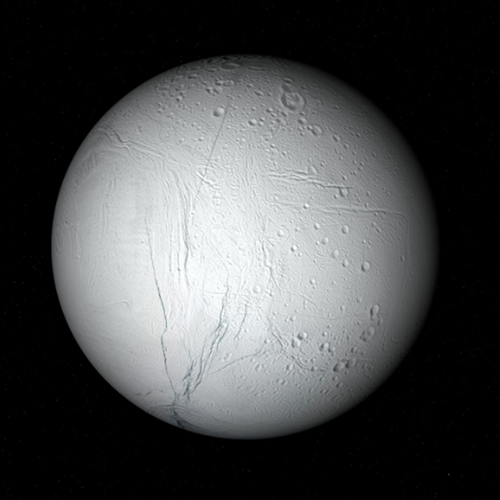
Scientists from the OU have helped find that organic molecules found in plumes from Saturn’s icy moon Enceladus could be formed by radiation on the moon’s surface, not just in its hidden ocean.
Enceladus, is covered in ice and famous for giant geyser-like plumes that shoot water, dust and ice into space. These plumes have been found to contain organic molecules, which are the building blocks for life. Many of these molecules are thought to come from Enceladus’s subsurface ocean, but the new study shows that some could also form on the surface or in the plumes themselves.
The new research recreated Enceladus’ icy surface in the lab. The scientists mixed water, carbon dioxide, methane, and ammonia ices and then bombarded them with charged particles to mimic radiation from Saturn. The experiments showed that this radiation alone can quickly create a range of organic molecules, including some that are important for forming amino acids, the building blocks of proteins. Some of these reactions happened over just a few days, and similar chemistry could even happen in the plumes themselves.
Grace Richards, lead author of the study, said: “While the identification of complex organic molecules in Enceladus’ environment remains an important clue in assessing the moon’s habitability, the results demonstrate that radiation-driven chemistry on the surface and in the plumes could also create these molecules.”
The study was part of Grace Richards’s OU doctoral research, and much of the experimental work was carried out during a research placement funded by Europlanet. The OU’s Dr Vic Pearson, Professor Manish Patel, Dr Simon Sheridan, and Professor Geraint (Taff) Morgan also contributed to the study.
The findings suggest that Enceladus’ surface and plumes may act as chemical factories, creating complex organic molecules. This has important implications for how scientists interpret the plumes and for planning future missions that search for signs of life beyond Earth.
Grace Richards is presenting the work at the Europlanet Society’s annual conference this week. The full research paper is available here: Water-group ion irradiation studies of Enceladus ice analogues: Can radiolysis account for material in and around the south polar plume?