

Last week, from 15 to 17 September, the 22nd edition of the International Conference on Semantics Systems (commonly known as SEMANTiCS) took place in the beautiful city of Ghent, Belgium. SEMANTiCS is a globally recognised venue where researchers, industry experts, and business leaders exchange knowledge on Knowledge Graphs and Artificial Intelligence.
This year’s theme “Bridging the Gap Between Curated and Induced Semantics” reflects the latest trend at the intersection of Artificial Intelligence and Semantic Web, which is neurosymbolic AI. There is a growing understanding that AI alone cannot solve all problems, and we need to help models with grounding their knowledge in curated data.
The conference attracted 437 delegates from all over the world, showing an astonishingly strong mix: 39% from academia, 37% from industry, 8% from research institutions, 7% from governmental agencies, and the remaining 9% unspecified.
This year’s program offered a large array of activities: 8 workshops, 5 tutorials, 11 paper presentation sessions (including Blue Sky ideas), 2 interactive sessions between industry and academic, a poster and demo session, a practitioners session, 2 keynote speeches, 2 invited speeches, a reception, a gala dinner, and plenty of networking. With regard to the keynote and invited speeches, SEMANTiCS attracted 2 superstars in the field of semantics and AI, namely Juan Sequeda (ServiceNow) and Deborah McGuinness (Rensselaer Polytechnic Institute), who have a long standing history in these fields, with plenty of experience and deployed technologies. In addition, SEMANTiCS attracted Alessandra Mileo (Dublin City University) as expert in Neurosymbolic AI, and Daniel Garijo (Universidad Politécnica de Madrid) who has provided insight in the latest developments of Ontology Engineering with LLMs.
This edition was a success on many accounts. First, we registered the highest number of participants in the history of SEMANTiCS, signalling a strong interest in these themes. Furthermore, the venue was stunning, well-equipped, and highly functional to host a conference of SEMANTiCS size. The catering was excellent. The city of Ghent is a true gem, allowing participants to dive into the latest technologies offered by SEMANTiCS while being surrounded by its medieval grandeur. Finally, the technical level offered by SEMANTiCS was on par with other conferences of the field, with opportunities for knowledge exchange and overall growth of the field.
For the fourth year in a row, KMi has played a crucial role in the organisation. In particular, Francesco Osborne acted as Programme Chair, developing the final and coherent 3-day programme, including all the planned activities.
Another KMi-er, Alba Morales Tirado acted as sponsoring chair, ensuring the conference respected all contractual obligations with the sponsors.
Finally, Marta Sabou, an ex KMi-er and now Professor at the Vienna University Economics and Business, was involved in the organisation of the Blue Sky Track, identifying the most ambitious, visionary, yet nonfictional papers for the community to reflect upon.
Finally, Angelo acted as General Chair, the most crucial role in conference organisation. As general chair, he was responsible for making decisions (e.g., which track to set, important dates, awards, and sustainability decisions), setting up the team (39 members through the various tracks and 17 volunteers at the venue for this edition), and establishing channels of communication between the various teams.
As an additional, perhaps slightly minor activity during the week, Angelo gave a keynote at the Symbolic and Generative AI for Science Workshop (SymGenAI4Sci 2026). In his talk “Did Semantics Fall Off the Metascience Radar?”, he reported on the journey semantic technologies have taken within the metascience field, and how they are now being challenged or replaced by Generative AI. Is there a future in which LLMs and Semantic Technologies can work together towards better solutions to advance metascience? That is yet to be seen.
After the conference, Angelo declared on social media:
“I am being overwhelmed by the positive messages around the success of #SEMANTiCS2026. I am thrilled that everyone had such a great time.
It is a complex machine that I could not have driven alone, and I am deeply grateful to have had such a great team.
As a next step, we are about to kick off preparations for #SEMANTiCS2027. I look forward to welcoming you to Bologna (IT).” (see post: https://lnkd.in/p/euBepeNm)
Angelo is committed to continue supporting SEMANTiCS as General Chair for another year, marking 5 consecutive editions in which KMi plays a key organisational role.
Looking ahead, the next edition of SEMANTiCS will be held in Bologna (IT), another crucial hotspot for semantic technologies. We look forward to another successful edition.
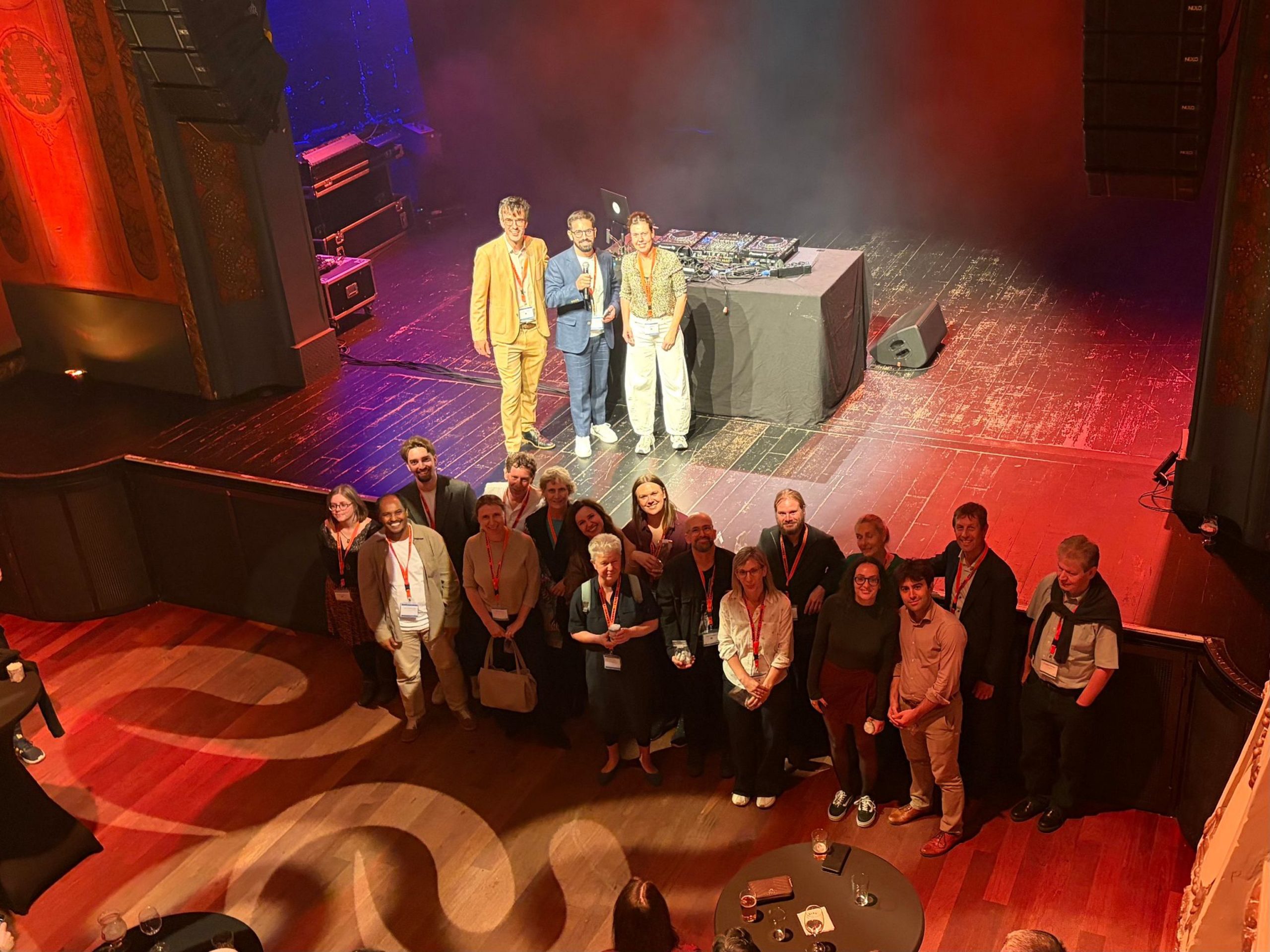
Note: Cover image includes the organising committee members who could make it to the conference.
From left to right:
- (on the stage) Pieter Colpaert, Angelo Salatino, Danica D’hont
- (on the floor) Femke Ongenae, Tilahun Abedissa Taffa, Daniil Dobriy, Marta Sabou, Frank van Harmelen, Annette ten Teije, Blerina Spahiu, Ute john, Julia Holze, Heiko Paulheim, Anastasia Dimou, Aad Versteden, Kathrin Füllenbach, Elena Lippolis, Martino Pulici, Marco Brattinga, Christian Dirschl.
External link:
- SEMANTiCS 2026: https://2026-eu.semantics.cc/
- SEMANTiCS 2027: https://2027.semantics.cc/